Forklifts for a critical spares room need to be available, quiet, emission-free and compact, not heavy-duty. That applies to a plant's maintenance storeroom and to a data center's spare-parts room alike. The loads are rarely heavy. What matters is a truck that can work tight indoor aisles at three in the morning, because a line or a server hall waiting on a part costs far more than the truck.
The Cost Asymmetry
In a critical spares room, a forklift is chosen for availability and access, not lowest cost per pallet. A shutdown caused by a part nobody can reach costs more than the entire fleet.
A distribution operation picks trucks to move the most pallets per hour for the least cost. Every decision trades throughput against cost.
A spares room flips that. The inventory exists to prevent downtime. In a plant, it includes motors, bearings, gearboxes, drive belts, rolls, dies and molds. In a data center, it includes drives, power components and cable assemblies. The handling equipment exists to make that inventory reachable.
Because downtime costs so much, availability and access come before everything else, including purchase price.
Most warehouse buyers would call that spec too much truck for the load and too small for the budget. It is neither. It is matched to a different cost of failure.
What Forklift Does a Spares Room Need?
A critical spares room needs compact electric forklifts, often with lithium batteries, plus order pickers for piece picking. Here is what that means in practice:
- Electric, almost always. No emissions indoors matters in any enclosed storeroom. In clean or controlled spaces, it is a hard requirement.
- Quiet. People work next to these trucks in spaces already loud from plant equipment. A quieter truck is a real improvement in working conditions.
- Lithium where the duty cycle justifies it. Duty cycle means how many hours a truck works and how hard. Many plants run around the clock. There is often no window to take a truck offline for a battery change. Charging lithium during breaks removes the problem.
- Compact. Storerooms are rarely built for lift trucks. Three-wheel electric counterbalance trucks and walkie stackers fit where a four-wheel truck cannot turn.
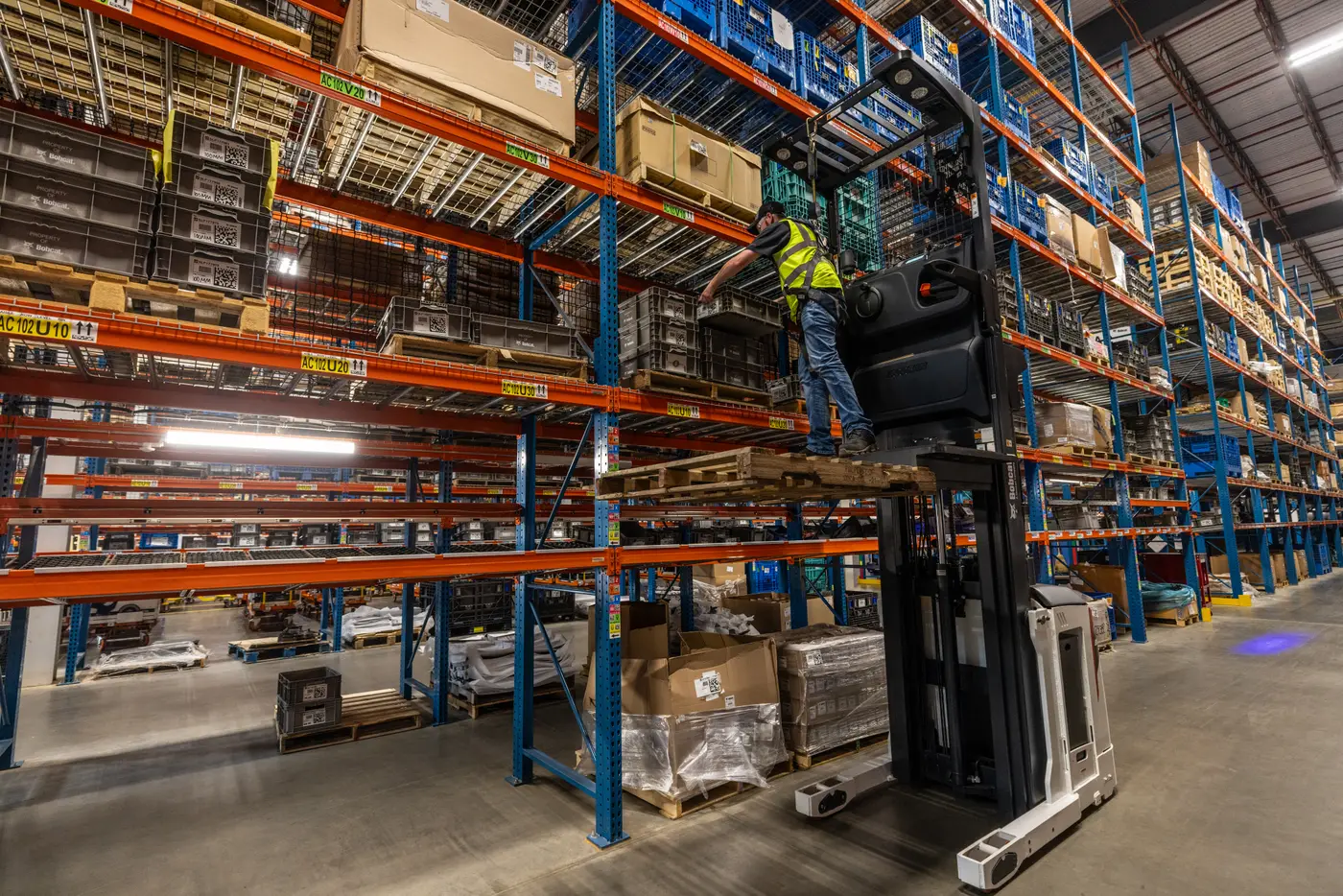
- Order pickers where the picking is by piece. Most spare parts are not on full pallets. An order picker takes a person straight to the item. That beats a counterbalance truck bringing a whole pallet down.
- A real maintenance plan. A planned maintenance program matters more here than fast breakdown response. The goal is that the truck does not fail in the first place.
Storage Design and Equipment Are One Decision
In a spares room, the storage and the forklift must be chosen together, and both should favor access over density.
Deep-lane storage such as drive-in, push-back and double-deep gains pallet positions by burying inventory behind other inventory. In a spare parts room, that is exactly wrong.
The pattern that works looks like this:
- Shallow selective racking with wire decking
- Every SKU on a pick face
- Carton flow for fast-moving consumables
- Cantilever for long stock and cable reels
That layout calls for compact trucks and order pickers, not deep-reach equipment.
The point is simple. Dense storage plus equipment bought to serve it makes a slower storeroom. Accessible storage matched with modest equipment makes a faster one.
Heavy Spares and Outdoor Work Are a Separate Fleet
Heavy spares and outdoor project work need pneumatic-tire IC forklifts, the opposite of the indoor storeroom fleet.
Large motors, rolls, transformers and structural steel often sit in a yard or a laydown area. Moving them over rough or gravel ground is work for pneumatic-tire internal combustion (IC) trucks, with spare capacity sized to the real load. On truly rough ground, a rough-terrain forklift such as a Sellick is the right tool.
Two points stand out:
Rent for projects. Plant shutdowns, expansions and construction come in phases. The machines are expensive to own and to store between phases, and use comes in bursts. Renting usually wins.
Keep the fleets separate. A truck bought as a compromise between an indoor storeroom and an outdoor laydown yard does both jobs badly. Where a site needs both, it needs both.
Working Around Live Operations
A critical spares room cannot go dark, so delivery, service and replacement must be planned around live operations. It is not an afterthought.
In practice, that means:
- Service scheduled around the windows the facility tells us matter
- A replacement or rental unit ready when a truck comes off line, not after
- Delivery and handover arranged to fit access and safety procedures
- Maintenance intervals set by actual hours, not a generic calendar
Hours matter because round-the-clock work adds hours far faster than a five-day operation.
Operator Training in These Environments
Maintenance staff and technicians who use a powered pallet jack need OSHA forklift training and certification. This is often missed by people who do not think of themselves as forklift operators.
A powered pallet jack is a powered industrial truck under OSHA 1910.178. Anyone who uses one needs training, evaluation and certification, the same as any forklift operator. The rule gets missed most where handling equipment is a side task to the main job.
Certification is also specific to the truck type and the workplace. Training has to reflect the real conditions: tight aisles, shared space with other staff, plant equipment and restricted areas.
What We Need to Spec This
To spec a critical spares fleet, we need these details:
- What is stored, and how much of it is on pallets versus piece-picked
- Aisle widths and the tightest point of the route
- Door heights and any access limits
- Hours of operation and whether there is any window to take a truck offline
- What cannot be interrupted, and when the critical windows are
Give us those, and we will spec a fleet that fits the building and the risk. It will not simply be sized to a pallet count.