OSHA groups powered industrial trucks, including forklifts, into seven classes, numbered I through VII. The class matters for two reasons. It is how trucks get specified and quoted, and it sets the scope of operator certification. An operator certified on one class is not certified on another, and that catches many employers out during an inspection.
Class I — Electric Motor Rider Trucks
Class I forklifts are electric counterbalance trucks that the operator rides, seated or standing. This is the default indoor warehouse truck.
Class I trucks make no emissions and run quietly. They use cushion or pneumatic tires depending on the surface. Capacity is typically 3,000 to 12,000 lb.
Where you see it in Northeast Ohio: almost everywhere indoors. That includes distribution buildings along I-76 and I-77, food and consumer goods plants, and light manufacturing across Summit and Stark counties.
Class II — Electric Motor Narrow Aisle Trucks
Class II forklifts are electric narrow aisle trucks, such as reach trucks, order pickers and turret trucks. They work aisles too narrow for a counterbalance truck.
These are the machines that let a tall building use its height. A reach truck works aisles down to around eight feet and lifts beyond thirty.
Where you see it: the newer, taller distribution buildings in the region. Class II is rare in older plants, because there is usually not enough clear height to justify it.
Class III — Electric Motor Hand Trucks
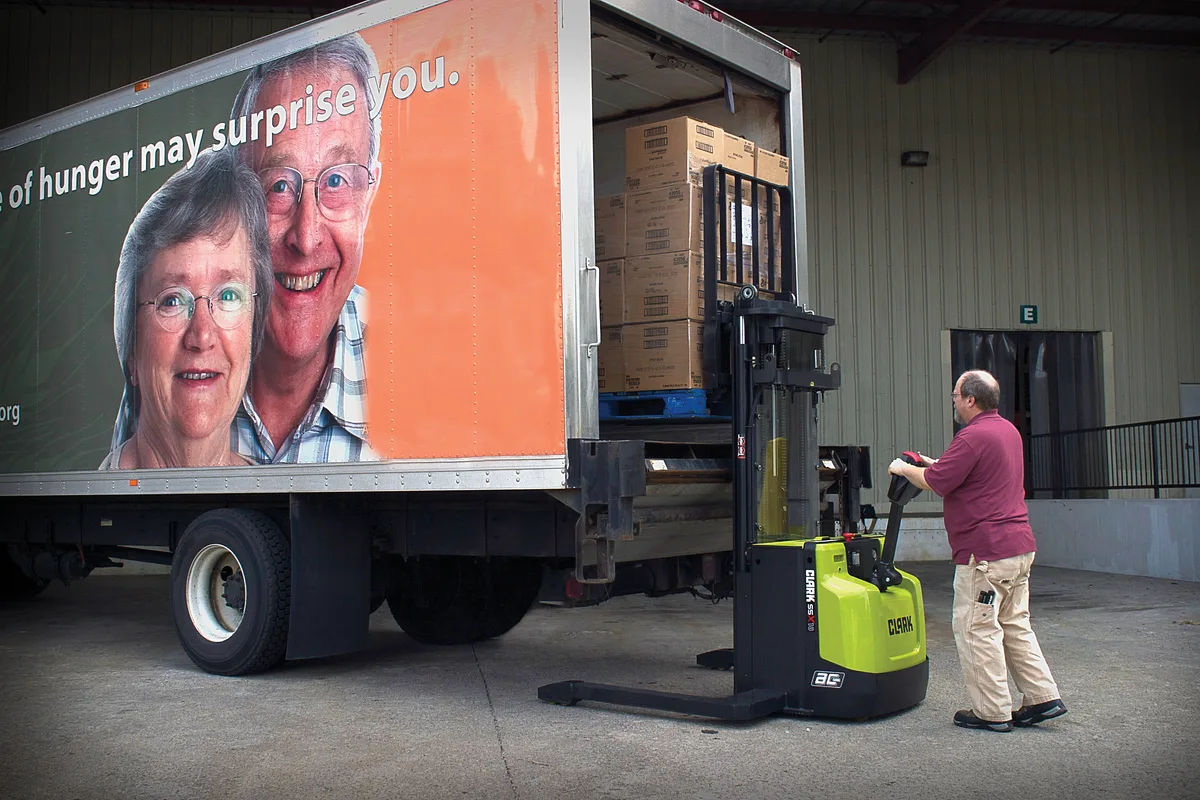
Class III trucks are electric walk-behind and walkie-rider trucks. They include electric pallet jacks, walkie stackers and, at the small end, low-level order pickers.
Class III is often overlooked, and it is often the right answer. A large share of pallet movement does not need a rider truck at all.
Where you see it: everywhere, but especially in small shops, retail back rooms and older multi-story buildings where a counterbalance truck will not fit.
Worth stating plainly: a powered pallet jack is a powered industrial truck. Operators need training, evaluation and certification under OSHA 1910.178, exactly as they would for a rider truck. A purely manual hand jack is not a powered truck, though safe handling training is still sensible.
Class IV — Internal Combustion, Cushion Tires
Class IV forklifts are LP or diesel trucks on solid cushion tires, built for indoor use on smooth floors. They suit operations that need internal combustion power, usually for continuous duty or capacity, on a good surface. They require proper ventilation.
Where you see it: polymer, rubber and metal plants, and older buildings where continuous duty leaves no time for charging.
Class V — Internal Combustion, Pneumatic Tires
Class V forklifts are LP or diesel trucks on air-filled or solid-pneumatic tires. They are the outdoor workhorse. This class also covers the heavy end of the capacity range, up to 40,000 lb and beyond.
Where you see it: lumber and building products yards, steel and scrap yards, truck terminals, and anywhere work crosses onto rough, unpaved ground.
Class VI — Electric and IC Tractors
Class VI trucks are tow tractors and tuggers. They pull instead of lift, moving carts and trailers in trains.
They are common in manufacturing plants and large facilities, where the job is moving material a distance, not stacking it.
Where you see it: large manufacturing plants feeding assembly lines, and bigger distribution buildings running cart-based restocking.
Class VII — Rough Terrain Forklifts
Class VII forklifts are rough terrain trucks: rough-terrain straight-mast forklifts and telehandlers. They run on large pneumatic tires, and most have four-wheel drive. Telehandlers also have a telescoping boom that places loads forward and up, not only up.
Where you see it: construction sites, lumber yards, nurseries, and contractor yards on rough, unpaved ground.
Note on capacity: telehandler capacity changes with boom extension and angle. A machine rated 10,000 lb with the boom retracted may carry a fraction of that at full reach. Operators must work from the load chart for the specific machine and attachment. That has to be part of their training.
What we supply in this class: we sell new Sellick rough-terrain straight-mast forklifts. We do not supply telehandlers. Across the other classes, we sell and service Classes I through V.
Why Does the Forklift Class Matter for Certification?
Forklift class matters for certification because OSHA requires operators to be trained on each type of truck they use. Most employers miss this.
OSHA 1910.178 requires operators to be trained and evaluated on the type of truck they will operate. Certification is specific to the truck type and the workplace. It is not a general license.
So an operator certified on a Class I counterbalance truck is not certified on a Class II reach truck, a Class III walkie or a Class V pneumatic truck. Each needs its own training and evaluation.
Re-evaluation is required at least every three years. It is required sooner in these cases:
- After an accident or near miss
- After the operator is seen operating unsafely
- When the operator is assigned a different type of truck
- When workplace conditions change
Once a business grows past one truck, it normally runs several classes. Your training records then need to show that, not a single certification per person.
How Do You Choose Between Forklift Classes?
The right forklift class follows the job. Work through these questions in order:
- Where is the work? Indoors points to Classes I, II, III and IV. Outdoors points to Class V, or Class VII on truly rough ground.
- What is the surface? A smooth sealed floor allows cushion tires. Anything worse needs pneumatic.
- How narrow are the aisles? Below about eleven feet, a counterbalance truck stops being practical and Class II becomes the answer.
- What is being moved? Full pallets point to Class I or II. Cases and pieces point to order pickers. Carts point to Class VI. Long or awkward material points to fork positioners and spare capacity.
- How high? Above roughly 20 ft, most buildings call for a reach truck.
Most operations of any size end up running more than one class. That is usually correct, not a sign of poor planning. A truck bought as a compromise between loading trailers and working narrow aisles does both jobs slowly.