Planned forklift maintenance costs less than breakdown repair. Scheduled work happens when it suits you, uses parts ordered ahead instead of rushed in, and stops small wear from turning into a major repair. Set service intervals by hours and duty cycle, not the calendar, and back them with a daily operator check.
Operations that resist planned maintenance have usually not weighed the cost of a day of downtime against the price of a service visit.
How Often Should a Forklift Be Serviced?
Service a forklift by its hours and duty cycle, not by the calendar. Servicing on a calendar is the most common mistake. A truck running two shifts in a dusty building wears several times faster than one doing a few hours a week indoors. Service both once a year, and one is over-serviced while the other runs to failure.
Set intervals by real hours and duty cycle (how hard and how long the truck works). As a rough guide:
- Light duty — a few hours a day, clean indoor space: longer intervals, typically quarterly
- Standard duty — single shift, normal warehouse conditions: the common baseline
- Heavy duty — multi-shift, dusty, outdoor, or high-cycle work: much shorter intervals
We set the schedule by the hour meter. Then we revise it once we see how that truck wears in that building. We do not apply a generic figure and leave it.
What a Service Visit Should Cover
A real planned maintenance visit checks the whole truck, not just the oil. It should include:
- Mast and lift system — chain stretch measured against tolerance, chain lubrication, roller and channel wear, cylinder condition, drift under load
- Forks — thickness at the heel against the condemnation point, cracks, bend, and that both forks match
- Hydraulics — fluid level and condition, hoses for chafing and cracking, cylinder rods for scoring, leaks at fittings
- Brakes and steering — pedal travel, parking brake hold on a slope, steering play
- Tires — wear against the line, chunking, separation
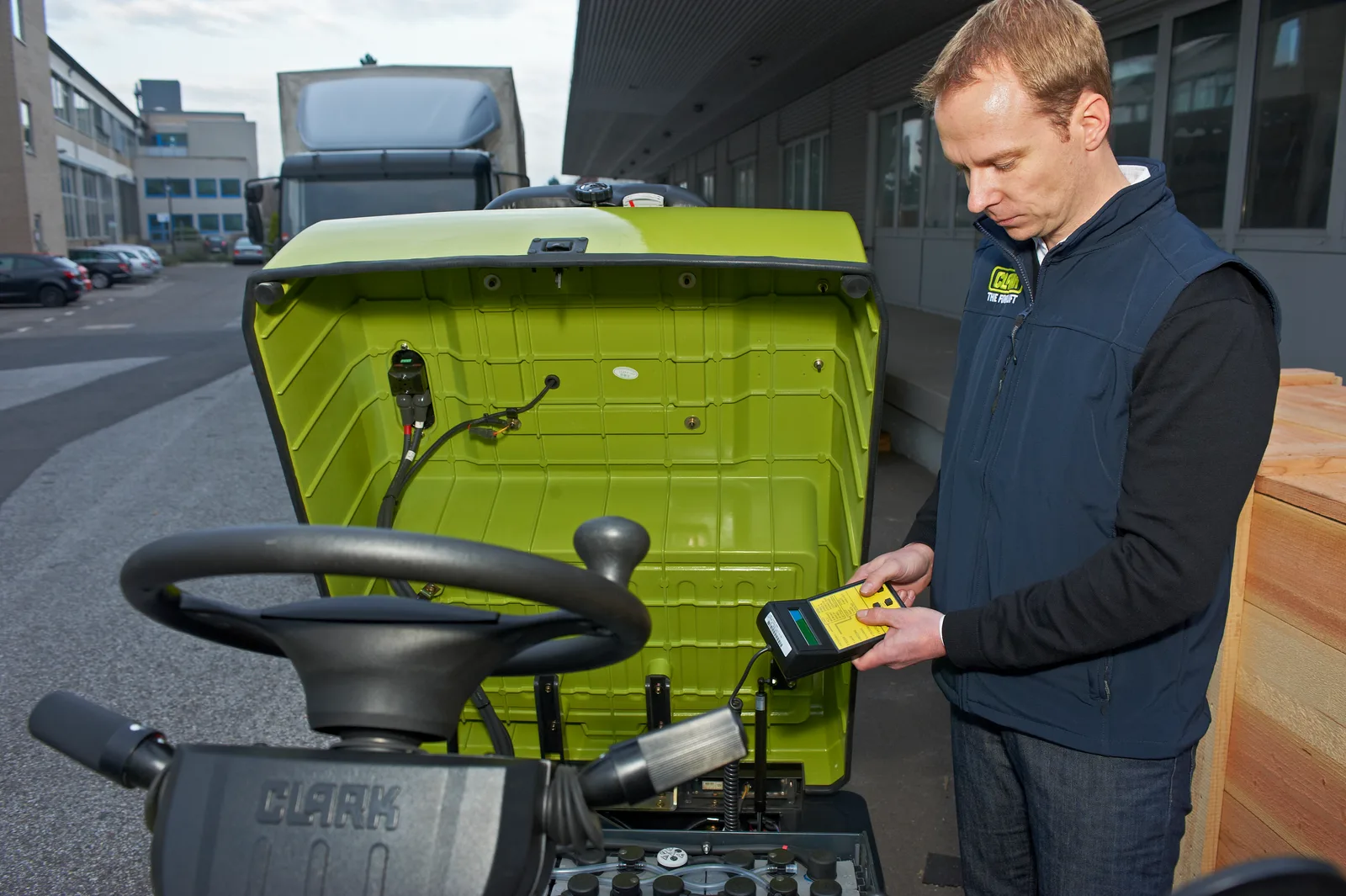
- Electrical — battery condition and specific gravity on lead-acid, connector and cable condition, charger function, fault code history
- Engine (IC) — oil, filters, coolant, belts, exhaust, emissions
- Safety systems — seatbelt, horn, lights, warning devices, overhead guard integrity, data plate legibility
Every visit should also produce a written record. That record is what you hand to a compliance officer or an insurer.
Winter Adds Its Own Checks
In Northeast Ohio, trucks that work outside or at the dock need extra attention in winter. Road salt, slush and freeze-thaw are hard on metal, wiring and batteries.
- Wash salt off the frame and undercarriage of yard and dock trucks
- Check coolant protection and cold-start behavior on IC trucks before the first hard freeze
- Watch battery connectors and cables for corrosion
- Check tires and brakes more often when docks and yards are icy
What Does the Daily Forklift Check Require?
OSHA 1910.178(q)(7) requires every forklift to be examined at least daily before it is placed in service. Where trucks run round the clock, they must be examined more often. Defects must be reported right away, and the truck taken out of service until they are fixed.
The daily check is the operator's job. It takes a couple of minutes, and it catches most of what we get called out for. A realistic pre-shift check covers:
- Visible leaks under the truck and around the mast
- Tire condition and pressure where applicable
- Fork condition — cracks, bend, heel wear
- Chains for obvious slack or damage
- Fluid levels
- Battery charge, connectors and electrolyte where applicable
- Horn, lights and warning devices
- Seatbelt condition and function
- Brakes and parking brake
- Steering for excessive play
- Data plate present and legible
Operators can do this check. The problem is check sheets signed in batches at the end of a week. A sheet signed without the check is worse than no sheet. It is a written record that the hazard was overlooked.
Mixed Fleets Are Normal
Most forklift fleets run more than one make after a few years of buying. That is not a planning failure. It comes from buying the right truck for each job instead of sticking to one brand for its own sake.
It does mean one service provider for every make is worth more than a slightly cheaper rate on one brand. That is why our technicians work on all major makes, not only the lines we sell new. Chasing three manufacturer service desks for one building is a cost nobody counts until they are doing it.
Battery Care Is Half the Life of an Electric Truck
On lead-acid batteries, maintenance is where most avoidable cost sits:
- Watering — after charging, never before, and only to the marked level. Chronic under-watering permanently cuts capacity.
- Avoid deep discharge — running below roughly 20% shortens cycle life a lot.
- Complete the charge cycle — cutting charges short on lead-acid causes sulfation. Lithium removes exactly this limit.
- Keep terminals clean — corrosion at connectors causes voltage drop and heat.
- Match the charger — a mismatched charger quietly destroys batteries over months.
Lithium removes watering, equalizing and sensitivity to deep discharge. That saves real labor as well as capacity. Lithium has its own needs, such as thermal management and the right charging setup, but they are lighter.
Signs a Truck Needs Attention Now
Call for service right away if a forklift shows any of these signs.
- Mast drifts down under load or lifts unevenly
- Visible hydraulic leaks, or fluid loss between services
- Steering play, long brake travel, or a parking brake that will not hold
- Unusual noise from the mast, drive or hydraulics
- Warning lights, fault codes, or intermittent starting
- Battery not holding charge through a shift
- Forks worn near the condemnation point, cracked or bent
Any of those is a call now, not a note for the next scheduled visit.
Putting a Fleet on a Schedule
A planned maintenance agreement puts everything above in writing. Each truck gets an interval set by its hours and a written inspection at every visit. You also get a record of what was found and what is coming due. We run these agreements across Northeast Ohio, including Cuyahoga County, on all major makes, so a mixed fleet sits under one schedule. Faults between visits go to service and repair.